A Jewel in Flight — The Swallow Tanager
The morning sun rises over the South American canopy, scattering light across emerald leaves and fruit-laden branches. From the shadows, a sudden flash of turquoise slices the air—swift, graceful, and impossibly bright. It is the Swallow Tanager (Tersina viridis), a bird whose colors seem borrowed from the sea and sky themselves. Its gentle, whistling calls drift through the forest like music, announcing its presence long before it perches within view.
Unlike many birds that fade into their surroundings, the male Swallow Tanager stands out with a brilliance that borders on surreal. His plumage glows a radiant turquoise-blue, offset by velvety black wings and a short, forked tail that gives the bird its name. The female, by contrast, wears subtler tones—olive-green above, pale below—perfect camouflage among the leaves where she tends to her young. This striking difference between the sexes is not mere ornament: it allows the female to remain hidden, while the male dazzles in displays of aerial artistry.
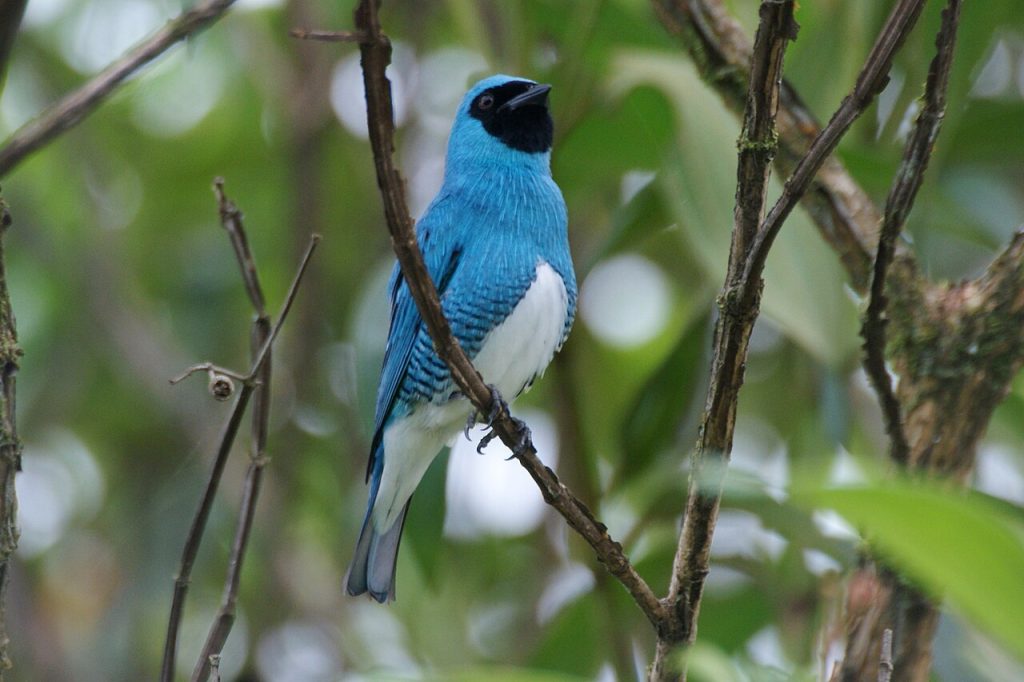
The Swallow Tanager inhabits tropical and subtropical forests stretching from Panama and Colombia down through Brazil, Paraguay, and northern Argentina. Though comfortable in dense woodland, it often ventures to forest edges, plantations, and even open gardens, making it more visible than many canopy specialists. Its diet is eclectic: berries and small fruits form a staple, but insects are eagerly pursued as well. In fact, its habit of swooping through the air to snatch prey recalls the flight of true swallows—a parallel reflected in both its name and its agile, looping movements.
During the breeding season, males transform into performers. Perched on exposed branches, they fan their tails, sing, and tilt their shining plumage toward the light, creating flashes of brilliance designed to catch the female’s eye. Nests are often placed in tree cavities or abandoned woodpecker holes, where the female lays her clutch of eggs. Both parents share the responsibility of raising the chicks, tirelessly ferrying fruit pulp and insects to the hungry mouths until the young are ready to fledge.
Thankfully, the Swallow Tanager remains a species of Least Concern in conservation terms. Its broad range and adaptability to semi-open habitats have kept populations stable. Yet, as with so many forest dwellers, the creeping threats of deforestation and fragmentation loom in the background. Should the great forests vanish, the brushstrokes of blue and green that this bird paints across the skies would fade as well.
For centuries, people have been enchanted by its brilliance. In local folklore and among modern birdwatchers alike, the Swallow Tanager is seen as a messenger of color and joy—a reminder that the forest holds not only survival and struggle but also pure beauty. Its name itself captures its dual essence: the swallow’s grace in flight combined with the tanager’s vibrant palette.
To encounter a Swallow Tanager is to witness art in motion. It is as if nature took up a brush, dipped it in turquoise and emerald, and released the masterpiece into the air. In its swift arcs and soft songs, the forest becomes a gallery, and the bird—a living canvas that reminds us how extraordinary even the smallest creatures can be.