The Forest’s Phantom: The Western Capercaillie
In the shadowed depths of a northern pine forest, silence breaks with a sound unlike any other—a strange medley of clicks, pops, and wheezes, echoing through the trees. Out of the gloom steps a bird of mythic stature: broad-winged, heavy-bodied, with feathers that glisten darkly under the canopy. This is the Western Capercaillie (Tetrao urogallus), a creature as mysterious as the old forests it inhabits, and one of Europe’s most iconic game birds.
A Giant Among Grouse
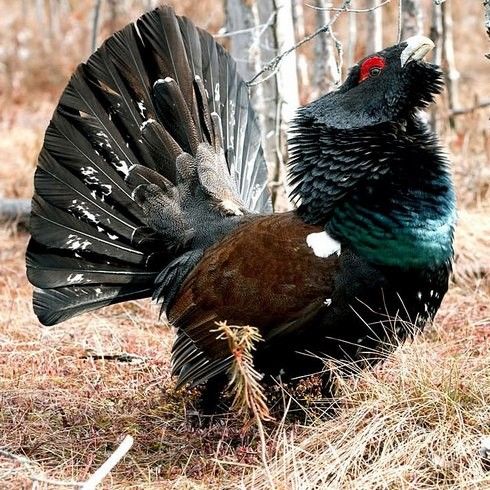
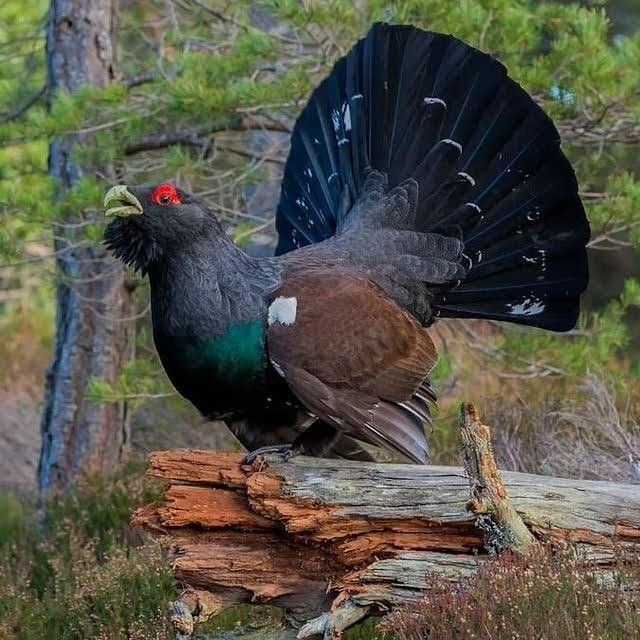
The Western Capercaillie is the largest member of the grouse family, with males reaching up to 4 kilograms in weight and nearly a meter in length. Males are cloaked in deep slate-black plumage, with an iridescent green sheen on the breast, a fan-shaped tail tipped in white, and a bold red eyebrow above each piercing eye. Females are far smaller and subtler, patterned in mottled browns and russets that blend perfectly with the forest floor. This stark dimorphism speaks to their different roles in survival: the male, a flamboyant defender of territory, the female, a master of camouflage.
Courtship in the Dawn
During spring, capercaillies transform the forest into a stage for one of nature’s most dramatic displays. Males gather in traditional lek sites, strutting and fanning their tails while producing their bizarre courtship song—a stuttering sequence of tok-tok-tok clicks and bubbling trills that build to a metallic wheeze. Females quietly observe, choosing the most dominant males for mating. The spectacle, performed in the misty half-light of dawn, has inspired countless legends among forest-dwelling peoples.
Life in the Pines
These birds are deeply tied to coniferous forests across Europe and parts of Asia, from the Scottish Highlands to the Siberian taiga. Their diet shifts with the seasons: in summer, they feed on berries, insects, and tender shoots; in winter, they rely heavily on pine needles, digesting what few other creatures can stomach. Chicks are especially vulnerable, needing protein-rich insects during their first weeks of life. Nests are shallow scrapes on the ground, where females lay up to a dozen eggs and raise the brood alone.
Fragile Guardians of the Old Forest
Once widespread, the Western Capercaillie has declined across much of its range due to deforestation, hunting, and habitat fragmentation. Sensitive to disturbance, these birds require large tracts of undisturbed forest with dense ground cover for shelter. In countries like Germany, Scotland, and parts of Central Europe, conservation projects are working to restore suitable habitats, restrict human intrusion, and carefully manage populations. Their survival has become a symbol of healthy, unbroken woodland.
A Bird of Legend and Lore
Throughout European history, the capercaillie has loomed large in folklore and tradition. Hunters once revered it as a prize of skill, while in mythology it was often seen as a guardian of the forest’s hidden heart. Even its name, derived from old Gaelic meaning “horse of the woods,” reflects both its imposing size and its deep-rooted cultural presence.
A Closing Reflection
To encounter a Western Capercaillie is to step into an ancient world where forest and bird are inseparable. Its size impresses, its song bewilders, and its very presence feels like a fragment of Europe’s primeval wilderness made flesh. As the forests shrink, so too does the echo of its strange dawn chorus. Protecting the Western Capercaillie means preserving more than a species—it means safeguarding the soul of the forest itself.